R E C I P I E N T S
J O I N T . M E D A L
|
|
|
THE ARK, A CULTURAL CENTRE FOR CHILDREN
Temple Bar, Dublin
Group 91 Architects /
Shane O'Toole and Michael
Kelly
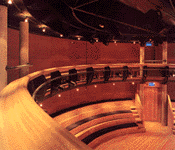
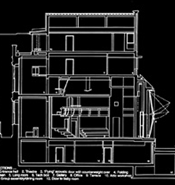
The Ark occupies the site os a 1725 Presbyterian Meeting
House, used throughout this century as a printing works and warehouse. The
1843 Ordinance Survey map shows a long hall, with stairs at both ends, giving
onto a galleried room behind. The new plan deliberately invokes the 'memory'
of that building in its form and dimensions. A new concrete 'facade' addresses
the brick wall: behind it is a concrete box, into which is inserted the
oak drum of the theatre. The footprint of the original building is reinstated,
as is, figuratively, the attic space, now a north-light studio workshop
concealed behind the front parapet.
The Ark's new facade, on Meeting House Square, is faced in brick and
stone and has attached metal elements, but its non-structural nature is
revealed by suspending it, so that it hovers just above the paving of the
square. A drop of 1.2 metres between the level of the street and the square
behind offered additional potential: large doors can be opened up to create
a natural raised stage for outdoor performances to the square, in which
The Ark's theatre becomes a stage to the square's auditorium. |
|
BLACK CHURCH PRINT STUDIOS
Temple Bar, Dublin
McCullough Mulvin Architects
On the site of the single-storey sculptors' annexe
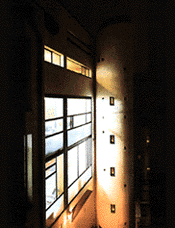
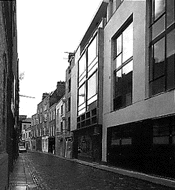
to Temple Bar Gallery and Studios, a new building has been constructed for
Black Church Print Studios. The Building will provide three floors of printing
facilities - screenprint, etching and lithography, with a print gallery
at street level. The facade of the building - gridded like a compositor's
frame of type-faces - has a blank panel behind which are the small-scale
processes and a larger area of windows to give the maximum light to each
printing floor. The top storey is set back to provide a roof terrace.
|
|
A W A R D S
|
|
|
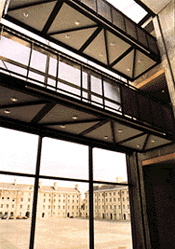
NATIONAL MUSEUM AT COLLINS BARRACKS
Dublin
Gilroy McMahon Architects/
Office of Public Works
In early 1994, the National Museum secured Collins
Barracks, Ireland's largest and Europe's oldest military barracks. The design
strategy transforms a defensive building complex into an accessible public
facility. All the public assembly functions of the museum - the audio-visual
room, the children's education rooms, the community meeting room, the bookshop
and the cafe - are located at ground level to open onto what is intended
to be a 'living sqaure'.
Office of
Public Works
|
|
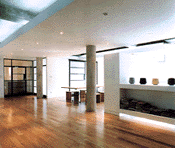
JOHN ROCHA DESIGN STUDIO
Temple Lane, Dublin
Group 91 Architects/
Derek Tynan Architects
This project is the fit-out of a two-storey commercial building -
part of the Printworks development - as design studio and offices for the
fashion designer John Rocha. The brief was to accomodate design functions,
periodic display of collections and central administration offices; actual
production and retailing taking place elsewhere. Two floors are interlinked
by double-height spaces over the pattern room and reception, allowing the
various activities to be visually connected. The principal objective was
to provide open, bright and calm spaces which successfully accomodate the
client's requirements.
|
|
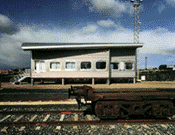
DUNDALK FREIGHT DEPOT -
CHECK-IN OFFICE
David Hughes,
Iarnród Éireann Architects
The overall design philosophy was to add interest
to a forgotten building type from industrial facilities, and to show how
the robust environment necessary can be tempered with humour and a touch
of style. The check-in office is the main control point for vehicles entering
and leaving the container depot. Two checkers handle the traffic. In addition,
three administrative staff and a manager work in the building. The building
also provides a canteen for the staff who work within the building and for
any drivers who may be in the depot.
|
|
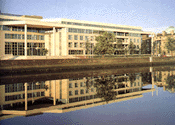
CIVIC OFFICES AT WOOD QUAY
Dublin
Scott
Tallon Walker Architects
During construction
of the existing tower blocks, the buildings along the quays and Winetavern
Street were demolished, opening up a view of the cathedral from the river.
The design solution of the new civic offices respects the views of Christchurch
Cathedral from the river, while continuing the architecture of the riverfront,
with a building block starting in line with the facades os SS Michael &
john's Church, and cranking to respect the line of the friary building to
the west of O'Donovan Rossa Bridge. The cranking of this building created
a portico as the main entrance to the Civic Offices, and a similar portico
was made to the corner of Winetavern Street to further enhance the view
to the cathedral. The design links the historic area directly to the spine
of the Temple Bar development and creates a new outdoor public space in
an area of the site where building could not take place because of a requirement
to protect the unexcavated part of this important Viking site. A gradual
rise in scale from the river to the original tower blocks helps to diminish
their dominance of river views. Similar granite cladding further integrates
the new buildings with the existing.
|
S P E C I A L . M E N T I O N S
|
|
|
FAMILY
APARTMENT
IN THE LIBERTIES
Dublin
MV Cullinan Architect
This flat for a young family is located
in an inner-city apartment building, built in 1994 on a busy thoroughfare
in the Liberties area of Dublin. The apartment is on three levels entered
from a common stairwell at second floor. The sleeping area accomodation
was located at entry level, allowing the living areas above to connect directly
to a roof terrace, which was added to take advantage of the southern exposure
and magnificent views across city rooftops to the Dublin mountains.
|

|
|
A
FOOTBRIDGE AT KELLS
Co. Kilkenny
Desmond FitzGerald Architects
The footbridge is designed as part of a
new footpath linking small village of Kells, a mill and priory, on two sides
of the river. The bridge's form developed from the natural flow of movement
from the mill-race island across to the priory. |

|
|
MUSEUM AT
MELLIFONT ABBEY
Co. Louth
McGarry Ní Éanaigh Architects
Located beside Mellifont Abbey in County
Louth, the project houses a small museum, canteen/office for the guides,
and public toilets. The location is beside Mellifont Abbey in County Louth.
There are three building elements - an existing derelict terrace house which
has been renovated as a single museum space, a new cedar timber box containing
the guides' facilities, built over an existing structure (now stone-faced)
containing the public toilets. Little of the original buildings of Meelifont
remain, but there are large amounts of worked stone and these form the subject
of the museum. A diaginal, folded sheet steel display divides the space
and determines the route by which visitors pass from ticket/reception desk
around the exhibition, out into the courtyard and from there to the abbey. |

|
|
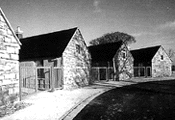
FOUR HOUSES
Tulach Ard, Rahoon, Galway
MV Cullinan,
National Building Agency
These four houses are part of a pilot scheme located
at the entrance to lands owned by Galway Corporation. The client intends
to open up these lands for a variety of public housing; the scheme illustrated
is intended to set the tone for future developments. There are three two-bedroom
houses and one single-bedroom house, laid out in a short crescent, facing
south onto an existing pair of trees. Each house is organized around an
entrance courtyard which opens onto the new access road. This, combined
with the stone-faced gable, allows for greater privacy on what will prove
to be a heavily trafficked route. |
|
|
HOUSE IN NORTH
COUNTY DUBLIN
O'Donnell
& Tuomey Architects
The architectural
intention is to integrate the small family house with its pastoral surroundings
by breaking up the volume into parts, grouped around a yard, to relate to
the traditions of existing farm buildings in the area. Local authority planning
restrictions stipulated a dormer bungalow as a mandatory requirement. The
timber-framed, zinc-roofed two-storey wing contains two bedrooms, bathrooms
and utility rooms. The lime-washed, blockwork, barn-like living area contains
a timber-frame study with a sleeping platform overhead. There are no corridors
in the house. Each part can be closed off or the whole house opened up. |

|
|
HOUSE TO LET
O'Muire Smyth Architects
The building is in a conservation area and, when purchased, consisted
of the external walls and roof, together with the remnants of the first-floor
beams. Our brief was to provide a house with three bedrooms, suitable for
letting, on a tight budget. The ground floor plan is ordered by a stepped
curved wall. The first floor is also ordered by the curved wall, returning
as a reverse curve at first-floor level, leading to the bedrooms, overlooking
the double height space and screen to the rear courtyard.
|

|
|
GARDEN
IN CORK
de paor
b arch
This is a scheme
for a garden to a terraced Victorian house in Cork city. The client lives
to the top of the house and wished to take advantage of the extraordinary
section. Replacing an existing shed, a large piece of garden furniture spans
from the existing house to the garden, providing a covered area to store
fuel and grow plants. A planted wired screen rises to the upper level. The
structure also carries water and electricity to the garden, while its upper
plant boxes hold a herb garden.
|

|
|
PRIVATE
RESIDENCE
Roebuck, Dublin
Derek Tynan Architects
This project is a renovation and extension
of a Victorian library as a private residence. The existing building, attached
to a large, villa-type dwelling, was originally the library of Seán
McBride, but recent development has left the library in a state of near
dereliction. The project is created around the two separate identities -
the refurbishment, as a conservation project, of the original library space,
and the addition of a similarly scaled two-storey addition to accomodate
bedrooms and further studio/living space. The kitchen is accomodated in
the glazed link joining the library to the original house. A slot of space
between the library and the addition forms the front entrance hall, from
which both the restored library and the stairs and studio are revealed.
|

|
|
SOLICITORS
OFFICES
Francis Street, Dublin
Derek Tynan Architects
This project is the renovation and extension
of a three-storey building as offices for a solicitor's practice. The basic
organisation is the use of ground level for public-related functions, with
general office and individual solicitors' offices on upper floors. The principal
design intention was to use the spatial intention of the long and narrow
site to interlink the various areas and to maintain the sun-lit aspect.
A two-storey, rooflit slot cut through the existing building, and the new
addition becomes the principal organising element of the lower floors and
allows light to penetrate onto the two-storey party wall.
|

|
A S S E S S O R S
Weil Arets (B. 1955) graduated from the Technical University in Eindhoven in 1983.
He established his own architectural practce in Heerlen, The Netherlands,
in 1983. Between 1986 and 1989 he taught at the Academy of Architecture
in Amsterdam and Rotterdam, and since 1991, has been a visiting professor
at various institutes in Europe and America. He is currently Dean at the
Berlage Institute in Amsterdam.
Gerry Cahill studied at University
College Dublin and the Architectural
Association. Worked in London and Dublin before establishing his own
practice in 1984. Has taught in the USA and UK, and is a studio lecturer
in UCD. Author of Back to the Street, and co-ordinator and editor
of Dublin City Quays. Winner of 1991 Irish Concrete Society Award
for Focus Housing Association Scheme at Stanhope Street, and a 1995 AAI
Award for Social Housing at New Street.
Michelle Fagan (b. 1966) graduated from Bolton Street DIT in 1990. Founder-member
of d-Compass. Worked with the OPW
on projects including the Waterways Visitor Centtre. Received an AAI Award
with NMA in 1992, before moving to Germany in 1993. Worked with OM Ungers
in Frankfurt-am-Main, and contributed to the Tales of Two Cities
exhibition in collaboration with Gary Lysacht and d-Compass. Currently
working in Berlin with Höger Hare/RKW.
Prof Cathal O'Neill graduated as an architect from
University College Dublin in
1955. He went on to study with Mies at IIT
in Chicago, where he graduated with a Masters degree in 1959. He subsequently
worked in Mies' office, and returned to Ireland in 1961 to set up his own
practice. He began lecturing in UCD in the early 1960s, and was also a
visiting lecturer to Trinity College, Dublin. In 1973 he was appointed
to the Chair of Architecture at UCD, a chair he still holds.
Ciarán Benson (b.1950) is Chairman of An
Chomhairle Ealaion / The Arts Council (1993-98). He is also Professor of
Psychology and Head of the Psychology Department in University College
Dublin. He has contributed to many aspects of arts policy and practice
in Ireland, including, most recently, The Arts Plan 1995-1997 and
Views of Theatre in Ireland 1995. He has published in psychology,
education and philosophy.


