







 | ||||
|
|
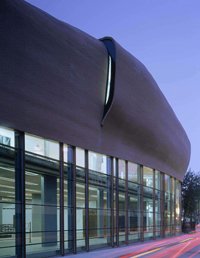
Philip Comerford Erik Van Egeraat's lecture to the AAI, intriguingly titled 'Tasteful architecture (the shameless and useless in architecture)', showcased the work and thinking of one of the most prominent practitioners to emerge from the current Dutch architectural renaissance. Van Egeraat, known in Ireland most notably for the recent extension to the Crawford Gallery in Cork, opened with 'Architecture should be tasted, not talked about.' This belief has led him to develop the notion of 'modern baroque', an architecture that reinstates the primacy of sensual experience, atmosphere and emotional response. Van Egeraat's own lecture mirrored this process, as a barrage of images including sunflowers, haut couture, ageing flesh and picturesque ruins flashed by in an effort to short-circuit the architectural thinking of his listeners. However Van Egeraat seemed to be arguing less for the slow, real-time discovery of place, and more for an updated multi-media version of the baroque art of illusion. 'Tasting' architecture instead of thinking it makes issues of quality irrelevant he believed. Unfortunately, such a reductive discourse runs the danger of raising more questions than it does answers. A statement such as, 'my mother would never want to live in Philip Johnson's Glass House' may draw appreciative chuckles from a room full of architects, but should we be happy with this level of cultural fragmentation ? Or does a truly innovative architecture always operate in advance of popular taste ? One would like to have learned more about how Van Egeraat saw the possibilities for his architecture of the senses in a world increasingly mediated through technology and virtual environments. Through heavy reliance on sophisticated computer techniques, this possibility was suggested in a largely virtual extension to the ETH in Zurich, one of the more interesting projects shown. The very idea of a 'modern baroque' seems open to question. Historically, Baroque architecture was often used as a mechanism for reinforcing existing power structures, notably by the popes of sixteenth century Rome. Looking at some of the twisting, computer generated facades of unrealized EEA projects, it is easy to see how these could become a cynical wrapping for unchallenged commercialism. Despite all the romantic zeal on show, pragmatism runs deep in the Dutch psyche. Van Egeraat constantly felt the need to remind us how cheap all his buildings were, even the blatantly expensive ones. It seems glamour and excess can only be tolerated in Holland if they can be delivered within a tight budget. Although his dialogue constantly polarized technology and feeling, the work of EEA increasingly exploits rationally conceived technology for expressive architectural ends. The realized projects that were finally shown provided the more satisfactory part of the lecture. This included the Crawford Gallery in Cork which achieves the rare feat of blending with its context by virtue of sheer strangeness. It is disappointing, however, that the amorphous character of the external envelope doesn't fold into the roofscape and affect the interiors more as was intended in the original competition drawings. Another project, the Rotterdam Technical College, provides an innovative solution to an educational brief, vertically stacking programs in an airy glass container that resembles an office building at first glance. Circulation loops guarantee intensity of social interaction, and a sparing use of materials such as screen-printed glass, timber and stone lend character to the spaces. The most formally restrained project shown, a housing scheme in Holland, also seemed the most intriguing, with large timber widows in a taut, composed fa�ade. It was impossible not to contrast the thought and resolution evident in most of these projects with the discourse that had gone before, leading us to perhaps the most disturbing question of all : Should architects be allowed to theorize about their own work ? Philip Comerford is an architect and is currently working with Shay Cleary Architects
|
|
|
| ||||
Architectural Association of Ireland
8 Merrion Square, Dublin 2, Ireland
© 1997-2004 Architectural Association of Ireland